Digimorph, An NSF Digital Library at UT Austin, Texas
help
DigiMorph
Browse the Library by:
 Scientific Names
 Common Names
 Cladogram
 What's New ?
 What's Popular?
Learn More
Overview Pages
A Production of

Tapirus bairdii, Baird's Tapir
Dr. Matthew Colbert - The University of Texas at Austin
Tapirus bairdii
Click for help
skull
Click for more information

American Museum of Natural History (AMNH 80076)

Image processing: Dr. Jessie Maisano
Image processing: Dr. Ted Macrini
Publication Date: 2002-02-14 00:00:00

Other tapirs: Tapirus terrestris, Tapirus indicus

ITIS TNS Google MSN

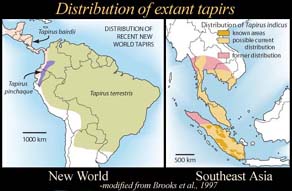
Tapirus bairdii, or Baird's tapir, is one of the four living species of tapirs. The range of Baird's tapir extends from southern Mexico through Central America to the northwest of South America, although information on the southernmost occurrence of this species is scanty. The range is actually much more fragmented than shown on the map on the left, Baird's tapir being absent from many areas of is former range (such as El Salvador, and apparently Ecuador), and extremely rare in other places, such as Colombia. Baird's tapir is listed as "Endangered" by both CITES - Appendix I, and the IUCN 2002 Red List.

tapir distribution

Distribution of Recent tapirs.

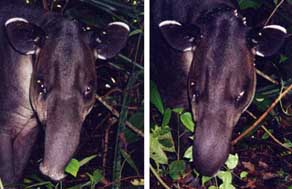
trunk

The tapir's muscular trunk.

All tapirs have a fleshy prehensile proboscis (a small muscular trunk), as seen in the thumbnail on the right. The trunk is made up of muscles of the face and upper lip. The intricate arrangement of these trunk muscles allow for a great deal of complex movement. Tapirs use their trunks when foraging - grasping vegetation, and moving items into their mouths. For more pictures of the tapir shown on the left, go to 'More Tapir Photos'.

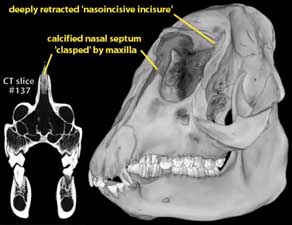
The presence of a muscular trunk is reflected in the architecture of the skull. All tapirs have a deeply retracted narial incision (nasoincisive incisure), tubercles and scars for the attachment of trunk musculature, and lack much of the bony wall of the nasal chamber (see Tapirus terrestris). The architecture of the skull of Baird's tapir is even more unusual in that it has the most extreme retraction of the narial incision among tapirs, and it also has a strongly ossified nasal septum that is clasped broadly by the upper edge of the maxilla.

skull

Skull architecture reflects presence of trunk.

About the Species

This specimen of Tapirus bairdii (AMNH 80076) was collected in Honduras, near Tela, in May 1926 by Goodhue Livingstone, Jr.. It was made available to The University of Texas High-Resolution X-ray CT Facility for scanning courtesy of Dr. Nancy Simmons of the Department of Mammalogy at the American Museum of Natural History. Funding for scanning was provided by Dr. Timothy Rowe of The University of Texas at Austin. Baird's tapir is one of several tapiroid perissodactyls included in ongoing research by Dr. Colbert.
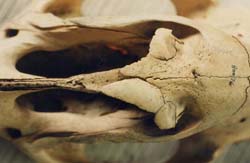
nasal bones

Unusual nasal development of AMNH 80076.

Baird's tapirs are known for the great morphological variability of their nasals (see Hatcher, 1896). This can be seen in AMNH 80076, which shows the unusual condition of a reduced right nasal, an extra ossification of the left nasal, and frontals (especially on the right side) which intrude between the two nasals to keep them from contacting one another. It is possible that the variability seen in T. bairdii nasal morphology is related to their extremely retracted nasoincisive incisure.

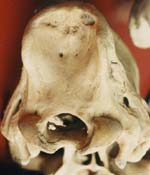
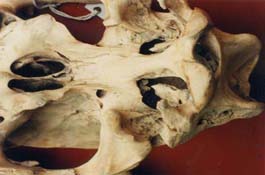
occiput

Occiput.

The well fused sutures in the basicranial region of the skull indicate that this was a relatively mature individual.

basicranium

Basicranium.

About this Specimen

The specimen was scanned along the coronal axis for a total of 395 slices, each slice 1.0 mm thick with a 1.0 mm interslice spacing. The scanning was done by Richard Ketcham, Cambria Denison and Matthew Colbert on 03 March 1998. The animations of Baird's tapir are reduced from the original data for optimal Web delivery. See the inspeCTor for unreduced CT data. Click on the thumbnail below to see the detail discernible in an unreduced sample slice through the braincase.
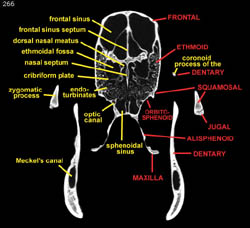
sample slice

Click on image to see an unreduced, labeled slice.

About the
Scan
Literature

Brooks, D. M., R. E. Bodmer, and S. Matola (compilers). 1997. Tapirs - Status Survey and Conservation Action Plan. (English, Spanish, Portuguese.) IUCN/SSC Tapir Specialist Group. IUCN, Gland, Switzerland and Cambridge, UK. viii + 164 pp.

Colbert, M. W. 2005. The facial skeleton of the early Oligocene Colodon (Perissodactyla, Tapiroidea). Paleontologia Electronica 8:12A:27p

Colbert, M. W. 1999. Patterns of Evolution and Variation in the Tapiroidea (Mammalia: Perissodactyla). Unpublished Ph.D. Dissertation, The University of Texas at Austin, 464 pp.

Colbert, M. W., and R. M. Schoch. 1998. Tapiroidea and other moropomorphs: in Evolution of Tertiary Mammals of North America. C. M. Janis, K. M. Scott, & L. L. Jacobs (eds.), Cambridge University Press, p. 569-582.

Hatcher, J. B. 1896. Recent and fossil tapirs. American Journal of Science 1:161-180.

Hershkovitz, P. 1954. Mammals of northern Colombia, preliminary report no. 7: tapirs (genus Tapirus), with a systematic review of American species. Proceedings of the United States National Museum 103:465-496.

Holbrook, L. T. 1999. The phylogeny and classification of tapiromorph perissodactyls (Mammalia). Cladistics 15:331-250.

Holbrook, L. T. 2001. Comparative osteology of early Tertiary tapiromorphs (Mammalia, Perissodactyla). Zoological Journal of the Linnean Society 132:1-54.

Lundelius, E. L., Jr., and B. H. Slaughter. 1976. Notes on American Pleistocene tapirs: in Essays in Palaeontology in Honour of Loris Shano Russell. C. S.Churcher (ed.), R. O. M. Misc. Publ. Athlon, p. 226-243.

Norman, J. E., and M. V. Ashley. 2000. Phylogenetics of Perissodactyla and tests of the molecular clock. Journal of Molecular Evolution 50:11-21.

Parker, W. N. 1882. On some points in the anatomy of the Indian tapir (Tapirus indicus). Proceedings of the Zoological Society 1882:768-777.

Paulli, S. 1900. Über die Pneumaticität des Schädels bei den Säugethieren. II. Über die morphologie des Siebbens und die der Pneumaticität bei den Ungulaten und Probosciden. Morphologisches Jahrbuch 28:179-251.

Radinsky, L. B. 1963. Origin and early evolution of North American Tapiroidea. Bulletin of the Peabody Museum of Natural History 17:1-115.

Radinsky, L. B. 1965. Evolution of the tapiroid skeleton from Heptodon to Tapirus. Bulletin of the Museum of Comparative Zoology 134:69-103.

Radinsky, L. B. 1965. Early Tertiary Tapiroidea of Asia. Bulletin of the American Museum of Natural History 129:183-263.

Reshetov, V. Y. 1975. Morphology of skull of asiatic Eocene tapiroid (Lophialetes expeditus Matthew et Granger, 1925). Journal of the Palaeontological Society of India 20:41-47.

Schoch, R. M. 1989. A review of the tapiroids: in The Evolution of the Perissodactyls. D. R. Prothero and R. M. Schoch (eds.), Oxford University Press, p. 298-320.

Simpson, G. G. 1945. Notes on Pleistocene and Recent tapirs. Bulletin of the American Museum of Natural History 86:36-81.

Witmer, L. M., S. D. Sampson, and N. Solounias. 1999. The proboscis of tapirs (Mammalia: Perissodactyla): a case study in novel narial anatomy. Journal of Zoology 249:249-267.

Links

The tapir gallery

Tapirus bairdii on The Animal Diversity Web (The University of Michigan Museum of Zoology)

For more pictures of Baird's tapirs, check out 'More Tapir Photos'.

Literature
& Links
Carate Beach

Jungle Habitat on the Osa Peninsula of Costa Rica.

The following images of Tapirus bairdii were taken by Matt Colbert in November, 2001, at Corcovado National Park on the Osa Peninsula of Costa Rica. More pictures of these tapirs can be seen at 'More Tapir Pictures'. The image above shows prime tapir habitat along the beaches just outside of the park at Carate. All of the tapirs shown here are part of a long-term radiotelemetry tracking project being conducted at Corcovado by Charles Foerster, who was kind enough to give a tour of his field site.

Rio

A young male tapir resting.

Because of their shy nature and secretive habits, we probably never would have found these tapirs had it not been for their radiocollars. Indeed, even though we were able to locate them within a few tens of meters, it still often took considerable time and patience to actually see the tapirs in their resting spots. When approached, the tapirs were shy but curious, and would often come out to get a better look, or perhaps smell, of us. These tapirs were all familiar with our guide, Charles - individual tapirs often having known him since they were born.

Dedo

A curious tapir.

Rio

A tapir swimming.

These photos were taken during the daytime, when tapirs are generally resting. As we approched them, they would typically get up after a bit and either leave directly, or feed for a while and then leave. The thumbnail on the left shows a young male tapir named 'Rio' (also seen on the upper left), who went into the water to feed on vegetation on the banks of the river.

During the course of his study, Charles Foerster has monitored 22 tapirs for more than five years. During the course of his observations, five females gave birth to eight offspring. Tapirs have one offspring at a time, with a gestation period of 13 months. The baby will stay with its mother for about a year. The picture on the right shows 'Big Mama' and her daughter 'Prima'. For more pictures of Big Mama and her daughter Prima, and one of her older sons, Dedo (also seen on the upper right), go to More Tapir Pictures.

Prima and Big Mama

Big Mama and Prima.

bones

Tapir bones at Corcovado.

Charles Foerster has also recorded three tapir deaths over the course of his radiotelemetry project.

Additional
Imagery

To cite this page: Dr. Matthew Colbert, 0:00, "Tapirus bairdii" (On-line), Digital Morphology. Accessed February 9, 2010 at http://digimorph.org/specimens/Tapirus_bairdii/.

©2002 - UTCT/DigiMorph Funding by NSF
Hits=21641. Comments to info@digimorph.org